“The challenge of our role is to be thermostats, not thermometers, which means not taking the environment’s temperature, but trying to change it.”
If we think about a conflict, we easily imagine a situation of violence and injustice and we easily expect an environmental “temperature” of rage, a sparkle ready to start a fire and an explosion.
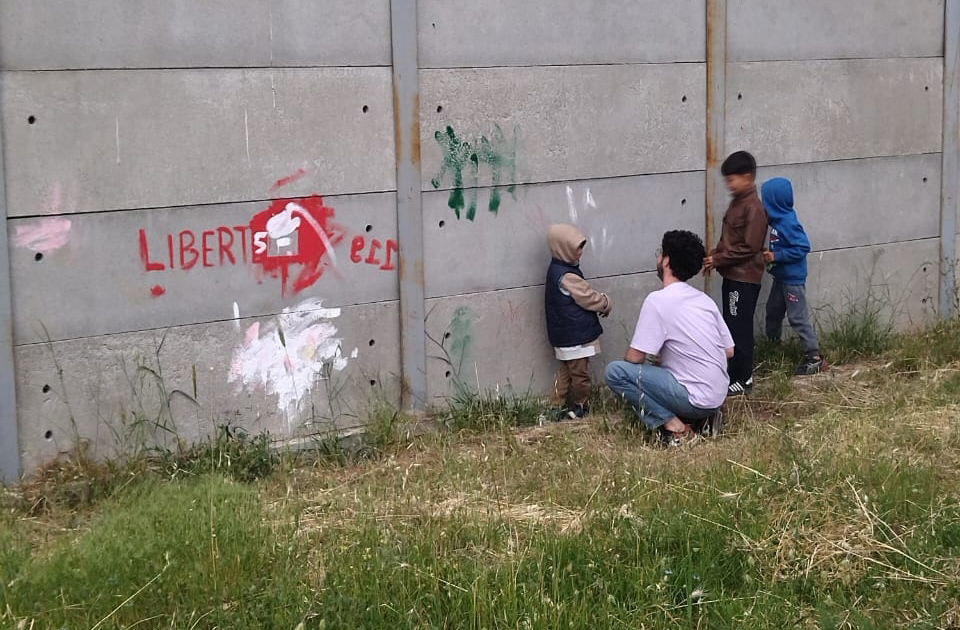
But in Greece – cradle of democracy, philosophy, classical art – where is the conflict? I have found it in the colourful graffiti on the walls of camps monitored by cameras and covered by barbed wire. I have felt it in the alarmed reaction of the camp’s private security, standing before our attempt to help a fragile person carrying a weight through the entrance checkpoint. I have seen it during the meetings around our tiny table, into the circumspect glances, checking who else was listening in the moment they start talking about their mother language, their own story. I have heard it in the voice of a father, telling us he could not take care of his own child inside a hospital wherein they spoke a language he did not know. I have felt it into the tears of frustration kept by a girl who could not bear to be exploited any longer at work.
As we monitor the compliance with people-on-the-move’s human rights here in Greece, everyday we live in contact with a system that seems to swallow everyone into its immobilism. It is a system made of prohibitions and boundaries: from the walls that keep out of sight the people living inside the camp, to the long wait to receive another rejection by the Greek asylum system; from the absence of public transport to reach medical care or language classes, to the difficulties in finding a job or a place to live in once outside the camp. It did not take much for me to understand that the “temperature” they breathe here is not rage, but resignation.
In these months I have sometimes been a thermometer myself and have found myself resigned too. Even if I do not accept it, I am no longer surprised by the fact that people are moved arbitrary from one camp to another to make space for new arrivals. Even if I do not accept it, I am no longer surprised by children not going to school, by the impossibility of seeing a doctor even for days sometimes, by waiting months to get enough money to buy a coat or a pair of shoes for winter.
In some cases, we have been able to change things these months, sometimes we have not. Still, people we met kept asking for us by their side. To blow candles off, to participate with them in a demonstration against war, during a funeral, to move in a new house, for a lawyer’s visit, for a picture with the Acropolis in the background. For them – I have understood this – the environmental temperature has changed thanks to our presence every time they could not feel alone facing an unjust and unknown system.
Written by Chiara Grazia Valenzano, Civil Peace Corp of APG23 volunteer in Athens
www.antennedipace.org/2026/01/20/temperatura/
 OPERAZIONE COLOMBA